
SUPERANNUATION: The Transfer Balance Cap (TBC) Is Changing…

What You Need to Know Before 1 July 2025!
The Transfer Balance Cap (TBC) is a key regulatory measure in
Australia’s superannuation system, designed to limit the amount
an individual can transfer into tax-free retirement income streams.
With changes coming into effect on 1 July 2025, understanding
how these adjustments impact your superannuation strategy is
crucial.
Understanding the Transfer Balance Cap (TBC)
The Transfer Balance Cap (TBC) was introduced on 1 July 2017 to limit the total amount of
superannuation that can be moved into a tax-free retirement phase income stream. While individuals
can accumulate unlimited funds in their superannuation accounts, they can only transfer up to their
personal TBC into the pension phase, where earnings are tax-free.
The Transfer Balance Account (TBA) is used by the ATO to track an individual’s usage of the TBC.
This account records:
• Credits (increases) when amounts are transferred into a retirement pension
• Debits (reductions) when funds are withdrawn or transferred out of the pension phase
Credits: What Increases Your Transfer Balance Account?
An individual’s TBA increases when they:
• Start a retirement phase pension, such as an account-based pension or defined benefit
pension
• Receive a reversionary pension (credited 12 months after the pensioner’s death)
• Begin a market-linked pension in the retirement phase
• Exceed their TBC, resulting in notional earnings on excess amounts
Debits: What Reduces Your Transfer Balance Account?
An individual’s TBA decreases when they:
• Make a full or partial commutation (withdrawal) from a retirement pension
• Transfer funds from a pension back to the accumulation phase
• Experience a family law superannuation split
• Have a pension balance adjustment due to fraud or bankruptcy
If the TBC is exceeded, the excess must be removed from the pension phase. Additionally, excess
transfer balance tax may apply.
Upcoming Increase in the Transfer Balance Cap (TBC)
From 1 July 2025, the general Transfer Balance Cap (TBC) will increase from $1.9 million to $2 million.
This adjustment also affects the Defined Benefit Income Cap (DBIC), which will rise from $118,750 to
$125,000 for the 2025–26 financial year.
TBC Indexation History
The TBC has been indexed periodically since its introduction:
• 1 July 2017 – Introduced at $1.6 million
• 1 July 2021 – Increased to $1.7 million
• 1 July 2023 – Increased to $1.9 million
• 1 July 2025 – Set to increase to $2 million
Indexation provides an opportunity for some individuals to transfer additional funds into the tax-free
retirement phase, but this does not apply to everyone equally.
How the Increase Impacts You
The increase in TBC benefits individuals who have not yet maximized their personal cap. However, if
you have already reached or exceeded your personal TBC, you will not receive the benefit of
indexation.
• If you commence a pension on or after 1 July 2025, your personal cap will align with the new $2
million limit.
• If you have previously used only part of your TBC, your cap will increase proportionally based
on your unused amount.
• If your TBC has already been fully utilized, the cap will remain at its current level, with no
additional room for indexation.
Example:
• If someone has previously used 50% of their cap, they receive 50% of the $100,000 increase
(i.e., $50,000).
• If they have fully used their cap, they do not benefit from the increase.
Your personal Transfer Balance Cap is calculated by the ATO, based on reported superannuation
transactions. Understanding this rule is crucial for those planning new pensions or additional
contributions before 1 July 2025.
Visualizing the Changes in Your Personal TBC
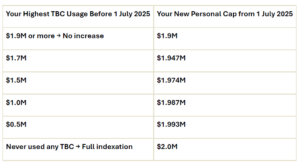
Strategic tip: If you are considering transferring more funds into a tax-free retirement phase, now is the time to plan before 1 July 2025!
The Impact of TBC on Retirement Strategies
The TBC directly influences Total Super Balance (TSB), which affects:
• Non-concessional contribution caps and the bring-forward arrangement.
• Eligibility for the government’s spouse tax offset and co-contributions.
Superannuants planning their retirement strategy should carefully monitor their TBA to ensure they do
not exceed their personal TBC.
Taxation of Defined Benefit Pensions
For those receiving defined benefit pensions, the Defined Benefit Income Cap (DBIC) restricts tax
concessions.
If a pension exceeds the DBIC ($125,000 from 1 July 2025):
• 50% of the excess will be taxed as assessable income for taxed pensions.
• Untaxed pensions exceeding the cap will be taxed at full marginal rates.
The 10% tax offset is limited to $11,875 per financial year.
What Happens If You Exceed the Cap?
Exceeding the TBC triggers action from the ATO, which requires the excess amount, along with
notional earnings, to be removed from the retirement phase.
• Commuting the excess back into the accumulation phase.
• Withdrawing the excess from the superannuation system.
The ATO issues an excess transfer balance determination, giving the member 60 days to comply. If no
action is taken, a compulsory commutation order is sent to the SMSF.
Tax penalties:
• 15% tax on excess earnings for the first breach.
• 30% tax on excess earnings for repeated breaches.
Transfer Balance Account Reporting (TBAR) Requirements
To maintain compliance, SMSFs must report transfer balance events to the ATO through Transfer
Balance Account Reports (TBAR).
• Quarterly reporting deadlines – Events must be reported by 28 January, 28 April, 28 July, and 28
October following the end of the quarter.
• Commutations due to excess balances – These must be reported within 10 business days of
month-end.
Responses to a commutation authority – Trustees must act within 60 days to avoid compliance
issues.
How KBD Professional Can Help
As the Transfer Balance Cap rises to $2 million, it is essential to understand how this impacts your
superannuation and retirement income strategy. Keeping track of your Transfer Balance Account,
meeting reporting obligations, and avoiding excess contributions will help ensure compliance. A wellplanned
approach now can prevent potential penalties and optimize your retirement savings.
Navigating superannuation regulations can be complex – Don’t Wait—Plan Ahead!
Contact KBD Professional today to ensure you stay compliant and make the most of the changes to
come.
Call us or complete the contact form on our website to book a consultation!